


Why
Exploding Heads
Neurons, Noise & Nightmares.
My art mainly comes from my dreams and my very vivid imagination tangled up with trauma and lived experience. The way my mind works has always fed directly into my work.
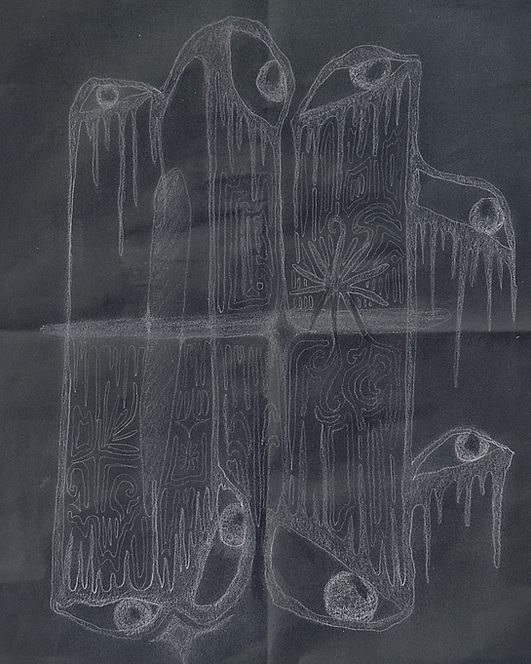
Recently, I started waking in the early hours of the morning convinced that someone was hammering on my door. The sound was so loud, so insistent, that I'd lie there certain it was real. My heart hammering, fully awake, nobody there. Every time it happened, it would be very hard to fall back asleep as I was begining to feel paranoid. After a while the frustration got to me enough that I googled it, and that's when I found out it has a name: exploding head syndrome. Essentially, your neurons misfire during the transition of sleeping into your waking life, generating a false auditory signal. The brain triggers its own alarm, waking the body with a sound that exists only inside it. Stress and PTSD can both bring it on.
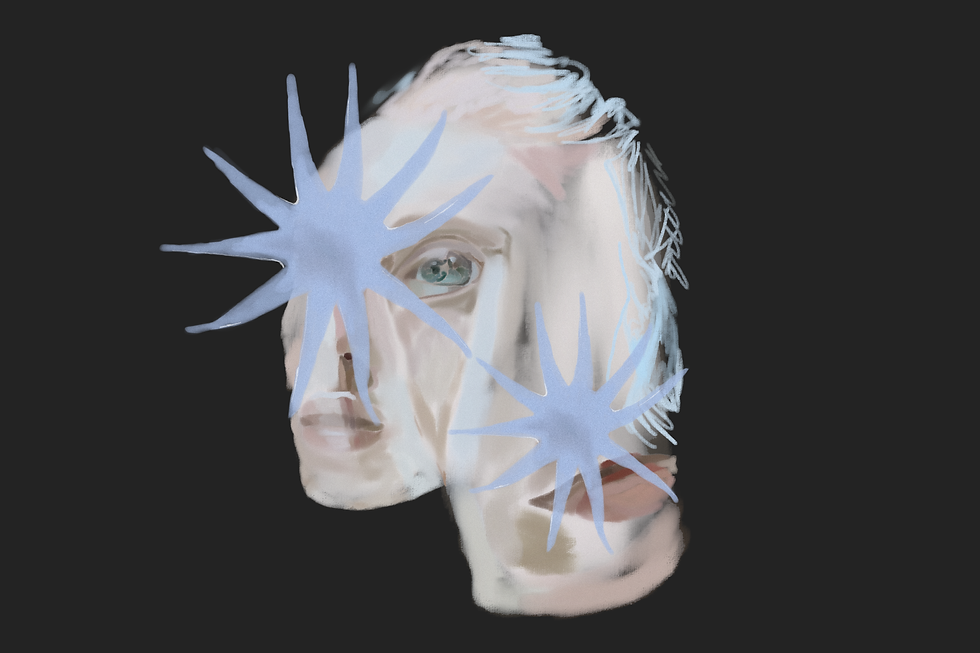
That discovery led me to the work in this edition. The exploding mind, that feeling of noise and pressure and something detonating behind the eyes, is something I live with in a general sense too, not just at 3am. I wanted to put that feeling somewhere. These pieces are where it went. That's why this edition is called Exploding Heads.
-Love S.
%20(6).png)

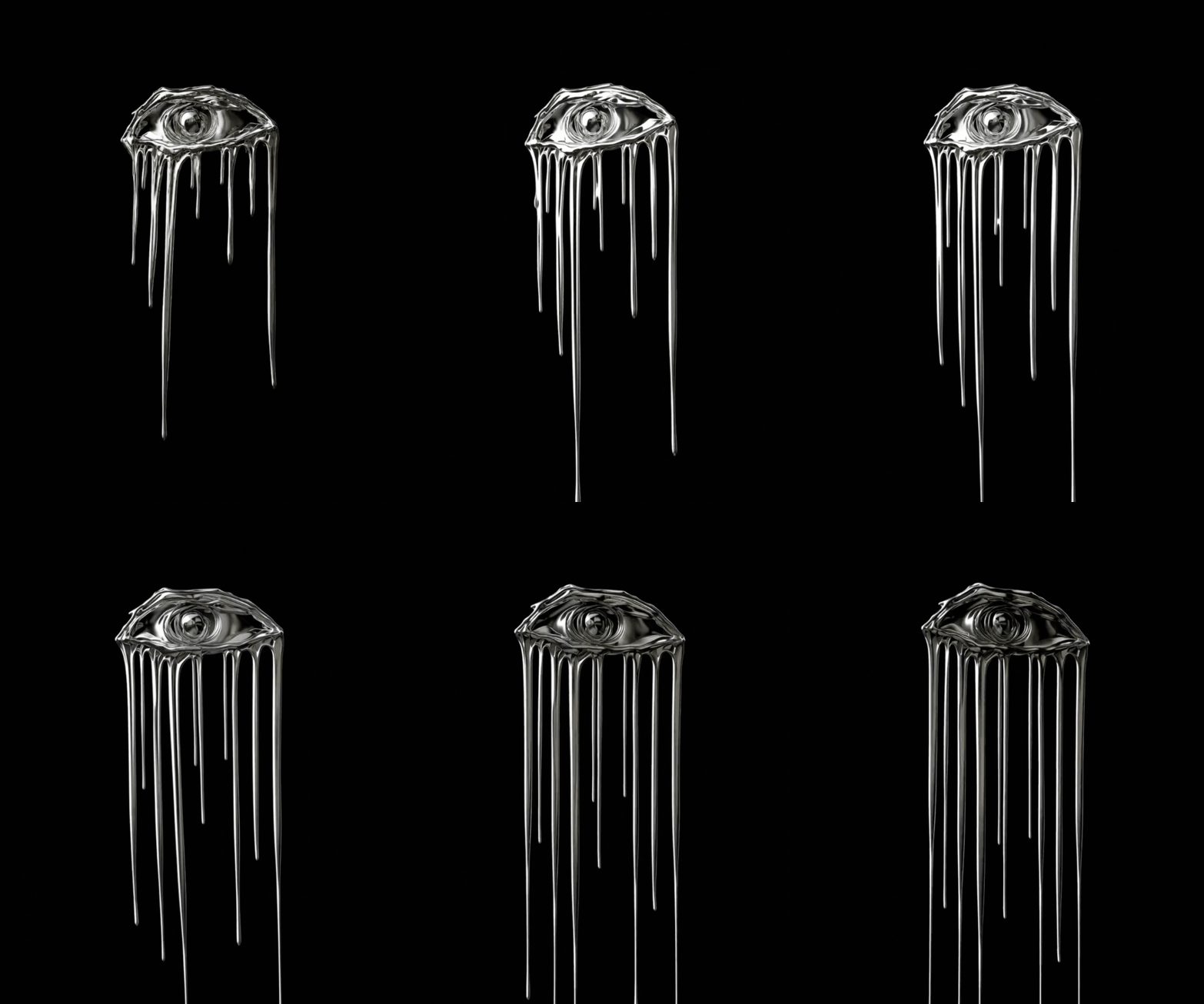
SKETCH > 3D RENDER > EDITING IN PROCREATE > PAPER MOCKUP > COLOUR BURN
EXPERIMENTAL SKETCHBOOK PIECES
%20(8).png)
%20(8).png)

%20(9).png)
.png)
The Aftermath Collection
The Aftermath is a collection about what violence does to a woman. Not the act itself but what comes after. The way it hollows something out and reshapes it. How innocence doesn't disappear yet it transforms the woman so much, quietly and permanently, into someone she didn't choose to become. Another version of her emerges. This collection is about her and the aftermath.
.png)


The Fantasy World I Built to Survive
And Why I'm Learning to Leave It
Recently, a friend said something that stopped me in my thoughts and made me question everything about myself. We were talking about my current fixation on the Dracula love story (btw I am happy to talk about this movie with somebody for hours!) the recent adaptation, and how deeply it's impacted the way I view yearning, love, and romance in a world that feels very nonchalant about all of it. I was explaining how I often escape into that fantasy and live there because it comforts me, because it's what my heart desires.
His response? "I think this is just your coping mechanism from trauma." I haven't stopped thinking about it since because it has opened my eyes. Ever since I was a young girl, probably around six or seven, I've been escaping into my own mind to seek a soothing self-expression, comfort, love, and a sense of understanding: both of myself and the world around me. For a long time, that felt like a positive thing. I was a creative, expressive child. I drew, I painted, I danced constantly, creating a world that felt completely natural. I didn't see any of it as a problem. It was just who I was. What I didn't fully understand back then was the extent of what I was actually doing. There's a term for it: maladaptive daydreaming. And for me, it was as natural as breathing. The zoning out and stepping into a world that was fair, ugly yet beautiful, colourful and expressive. A world that **understood** me. Because the real world was often filled with people who didn't (to say the least, abusive family members and later on abusive relationships), and that caused me a great deal of trauma throughout my childhood, teenage years, and early twenties. That creativity became my escape from everything I wasn’t ready to face yet. Though my late teens were marked by drug abuse and self-harm, art was always the thing I returned to. It was my comfort, my language, my way of expressing what I had no other words for. And unlike self-destruction, it gave something back. The artists who inspired me most were ones who understood pain and transformed it into some beautiful pieces that I also longed to create. Francis Bacon, Louise Bourgeois, Jean-Michel Basquiat, Tracey Emin. People who looked at the darkest parts of human experience and made something extraordinary out of them. That moved me deeply back then and it It still does now. This inner world has been with me every single day for as long as I can remember. I rarely feel completely grounded or at ease in this reality, maybe for a year or two here and there, but outside of that, I've mostly been living inside my head, trying to make something out of whatever I find there. I was fired from nearly every conventional job I held. Waitressing, office work in marketing, bar work. I just couldn't make peace with the idea that this is what I was going to do for the rest of my human life. So I used my creativity and whatever resilience I had to build something of my own: my own art business (although I rarely sold anything), photographing for companies, making things by hand, selling vintage clothes and now, art direction. A world of my own, where creativity and passion were the whole point. And as beautiful as that is, it comes with pain. As an adult with real responsibilities like bills, food, taxes, family, relationships, all the things that hold a life together, the gap between my inner world and the one I actually have to navigate becomes genuinely hard to manage. Even now, I find myself constantly drifting toward fantasies: where my art could take me, what my life could look like, who I could become, instead of focusing on the steps I actually need to take to get there. The fact that I work from home, alone, without a partner or children, only makes it worse at times. The daydreaming soothes me and gives me purpose. It's only recently that I've allowed myself to really look at this honestly. The escape, the fantasy, the retreating into my own mind: it is a coping mechanism. It's how I gave myself the comfort, understanding, and grace that I simply wasn't given when I was young. And acknowledging that has been... a lot. I genuinely believe that a vivid imagination is a beautiful thing. I love meeting people who think that way, who build strange worlds in their minds, who create. It gives me a real sense of belonging, because it confirms that there might be something beyond what's right in front of us. What complicates it is that that's not all life is. Bills exist. Responsibilities exist. And the longer we use fantasy as a place to hide from that reality rather than a place to create within it, the harder things become. There's a specific kind of pain and dissapointment that comes with maladaptive daydreaming that doesn't get talked about enough. When you finally surface from your inner world and come back to real life, real people, the ordinary and often mundane realit, none of it measures up to what you've built in your head. And that fucking hurts. And what's worse, you start creating expectations of people based on versions of them that only exist in your mind. Raise a hand if you’ve ever put on a rose coloured lenses when it comes to your relationships. I have, and it was heartbreaking because when they inevitably show you who they really are, the disappointment is real, even though it was you who created the scenario in the first place. That's not their failure. It's the projection. I struggle with expecting people to behave the way they would in my fantasy world. I know that. It's a selfish thing which I’ve been working on, especially to do with the matters of the heart. It's a kind of self-inflicted pain and while I have nothing but compassion for anyone who escapes this way, because they must have had good reason to, I also know that at some point we have to choose to come back. Especially when real life catches up to us. The other thing maladaptive daydreaming does is make you feel profoundly alienated. Even surrounded by people you love, when they can't quite follow where your mind goes, it creates a loneliness that's hard to explain. That's why I think it matters so much to find even just a few people who are genuinely curious about your inner world, people who want to explore it with you, maybe even create something alongside you. Because we're not alone in this, even when it feels that way. But I'll be honest with myself, and with you: you can never truly escape life's pain or its responsibilities by escaping into fantasy. The pain of everyday life will catch up. The imagination is a gift: one of the most powerful ones we have, especially in art, in creation, in expression. But it won't pay the bills, repair the relationships, or solve the problems quietly building in the background. The longer we escape, the deeper the hole gets. And one day it becomes very hard to climb out. I'm learning that. Slowly, but surely.

She Lived Before Me
These pieces are deeply personal to me, and to my grandmother.
She gave me a collection of photographs spanning the 70s. In them I found the woman she was before everything changed. The life she was living, the connections she had with many people, the world she moved through before it drastically changed and came crumbling down. And tucked behind some of the portraits, were love notes from a past lover. Someone she never ended up with, separated in the end by different cities and different lives.
Those photographs and especially the love notes about how much they loved eachother yet couldn't be together, hit me somewhere I wasn't expecting. There was so much aliveness in them. So much joy and love. So much that almost didn't survive.
When I worked with them, I wasn't interested in showing her face, or anyone else's. What I wanted to capture was her aura and the presence of her but brought into a slightly different world than these photographs ever thought they'd exist in. Old analog images handled in a new way. Hers, but also now mine.


Artists Who Shaped My Style
As an artist, being inspired by other creators is everything. The way they work, the artwork that touches your soul, the pieces that quietly shift how you see the world and how you make things. Since graduating college, a handful of artists have fundamentally shaped my style, my aesthetics, and my understanding of self-expression. What they all share, across very different mediums, is expressive mark-making: raw, unapologetic, and deeply human.
Francis Bacon
Starting off strong. I began studying Bacon's work in college and I think his paintings are absolutely brilliant. He works in a deeply expressionist style: distorted faces, rough abstract backgrounds, unsettling formations. The main thing that pulled me in was how much emotion lives inside that disturbing distortion. He didn't lead an easy life, and you can feel that. These are not pretty paintings. They're gruesome, dark, and thought-provoking in a way that isn't meant for everyone, and I think that's exactly what makes them so special.
His triptych pieces in particular, the ones that show movement or transformation, are uncomfortable to look at but that discomfort is the whole point. Art should make you feel something, and Bacon makes me feel genuinely unsettled in the best possible way. I actually based my end-of-year exhibition piece on his triptychs: a distorted face, worked from a free stock image that I photoshopped and then painted onto massive 1.5 by 1.5m canvases. I was a beginner then, but it was my entry into abstract expressionism and what it means to distort the human form. Due to my own life experience, his work resonated with me deeply. The sense that you're not the only one with a fractured view of humanity, that pain can be made into something. What I value most is his ability to distort the human form while keeping it just decipherable enough that you know what you're looking at.
Louise Bourgeois
Louise Bourgeois is a French-American artist whose work spans sculpture, sketches, and painting. I was drawn first to her sketches, the loose mark-making, the abstract forms, the almost earthy quality of them. They feel liberated, like fragments of her imagination rather than finished compositions, and that introduced me to the idea that great art doesn't have to be contained or complete. You can put your raw thoughts directly onto paper and that itself is the work.
I also love her red pen pieces, which connect so personally to her relationship with her father. And then there's the spider sculpture, almost subconsciously, that piece altered my art. The long legs, which sometimes read as wings depending on the piece, and the way the sculpture connects to the human form, crept into my own work. I didn't notice it at first, but I kept adding spider legs and wing-like forms to my own pieces. Bourgeois taught me that your art can live in its own world and still make complete sense.
Jean-Michel Basquiat
This one is a no-brainer. A brilliant Brooklyn artist who started as a broke graffiti writer, handing out postcards and tagging buildings, before being recognized by names like Andy Warhol. He died at 27 from a drug overdose, which makes the sheer volume and intensity of what he produced even more staggering.
His work is extremely expressive, raw, symbolic, emotionally loaded. Watching his interviews, I felt like he was a deeply sensitive person, and art was how he let suppressed anger out without looking angry. You can trace the weight building on him as his career progressed: the socializing, the recognition, the pressure. It's all there in the evolution of his paintings. What I took most from him was his expressive mark-making, his use of symbolism, and his obsessive relationship with blue was that particular blue that lives in his canvases. He broke every rule and it worked completely. To me, it's the ultimate cool kid art. Jack Kabangu Jack Kabangu is a contemporary artist I had the pleasure of seeing at Saatchi Gallery in London. I'd followed his work before visiting but nothing quite prepared me for seeing the paintings in person. I was genuinely awestruck. His colour blocking is exceptional. It works perfectly for his style: bold, immediate, impossible to walk past. The work grabs you and makes you ask whether there's more beneath it, or whether the surface is the whole point. He inspired me to simplify my work and to strip back the forms and subjects in my own work and trust the colour to do the heavy lifting. His pieces work as a whole without needing detail to justify them. And there's no mistaking a Kabangu for anything else, which I think is one of the most important things an artist can achieve: a style so authentic you can recognize it across a room. Björn Melgaard Björn Melgaard is a Norwegian abstract expressionist I first encountered at Saatchi Gallery during my college years. The painting that stopped me was Untitled Daddy Daddy: a strong blue against two almost comic-like faces with loose, gestural brushstrokes. I can't fully explain why it had such an effect on me. I just know that I still remember it after a decade, and that says everything. Kurt Cobain This one isn't a traditional inclusion so when I mention Kurt Cobain here, I mean his drawings. Hidden in album covers and personal diaries are sketches that are so easy to dismiss as doodles, but to me they spoke loudly. Skeleton-like forms, strange artifacts, comic-style narratives: they carry an unsettling quality not unlike Bacon, but stranger somehow. Less creepy, more confusing. I often genuinely don't know what I'm looking at, and I'm drawn in anyway. His work pushed me to think more surrealistically, to let the imagination move away from the everyday and into somewhere stranger and less defined. Tracey Emin Tracey Emin's work is brilliant — feminist, raw, thought-provoking. The rough mark-making in bold reds, blacks, and blues, the writing layered over the image, the sense that every piece is bleeding something real. I see pain and rebellion in her work, which resonates with me deeply because that's what I lead my own art with too. Seeing a woman express herself so nakedly, not performing beauty, not making it comfortable, was genuinely inspiring to me as a young female artist with a lot hidden inside. Many of her pieces look unfinished, deliberately rough, unbothered by perfection. To me that IS the work. The form, the context, the story matter more than technical finish, and through that she shows what female rebellion actually looks like. Pain, memory, and abstract form are central to my own work too, and Emin gave me permission to trust that. Together, these artists cover a wide range of mediums and subject matter, but they share something I keep coming back to: a way of expressing themselves that is instinctive, sometimes primitive, sometimes infantile, sometimes tragic. None of them are making art just to look good on a wall. They're making art that means something. About pain, identity, rebellion, humanity. An artwork that makes you feel something is a great artwork, full stop. That's the standard I hold myself to as well.
.png)
I HAVE NEVER MET SOMEBODY LIKE YOU
ART PRINT

BEFORE THE UNDOING
ART PRINT
.png)
CRUSHED VELVET
ART PRINT


THE MOTHER
ART PRINT X OIL PASTELS
A4
Cut from the same cloth Collection
A mixed media collection exploring intersocial ties and dynamics when faced with different life experiences and beliefs.
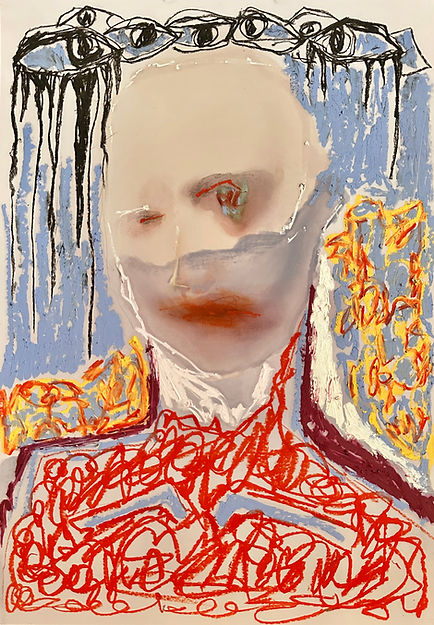
THE FATHER
ART PRINT X OIL PASTELS
A3

VILLAGE GIRLS
ART PRINT X OIL PASTELS
A4

I WILL SHOW YOU LIFE SON
PEN X OIL PASTELS
A4
.png)
THE LOVERS
ART PRINT X OIL PASTELS
A4

FAMILY EXPECTATIONS
ART PRINT X OIL PASTELS
A4
cut from the same cloth vol 2


